





Which RAM Trucks Are Best for Slide-In Campers in Wyoming?
Match your slide-in camper to the right 4x4 RAM payload capacity, rear axle setup, and powertrain designed for Wyoming terrain and I-80 crosswinds.
Matching Your RAM Truck to Wyoming’s Rugged Terrain
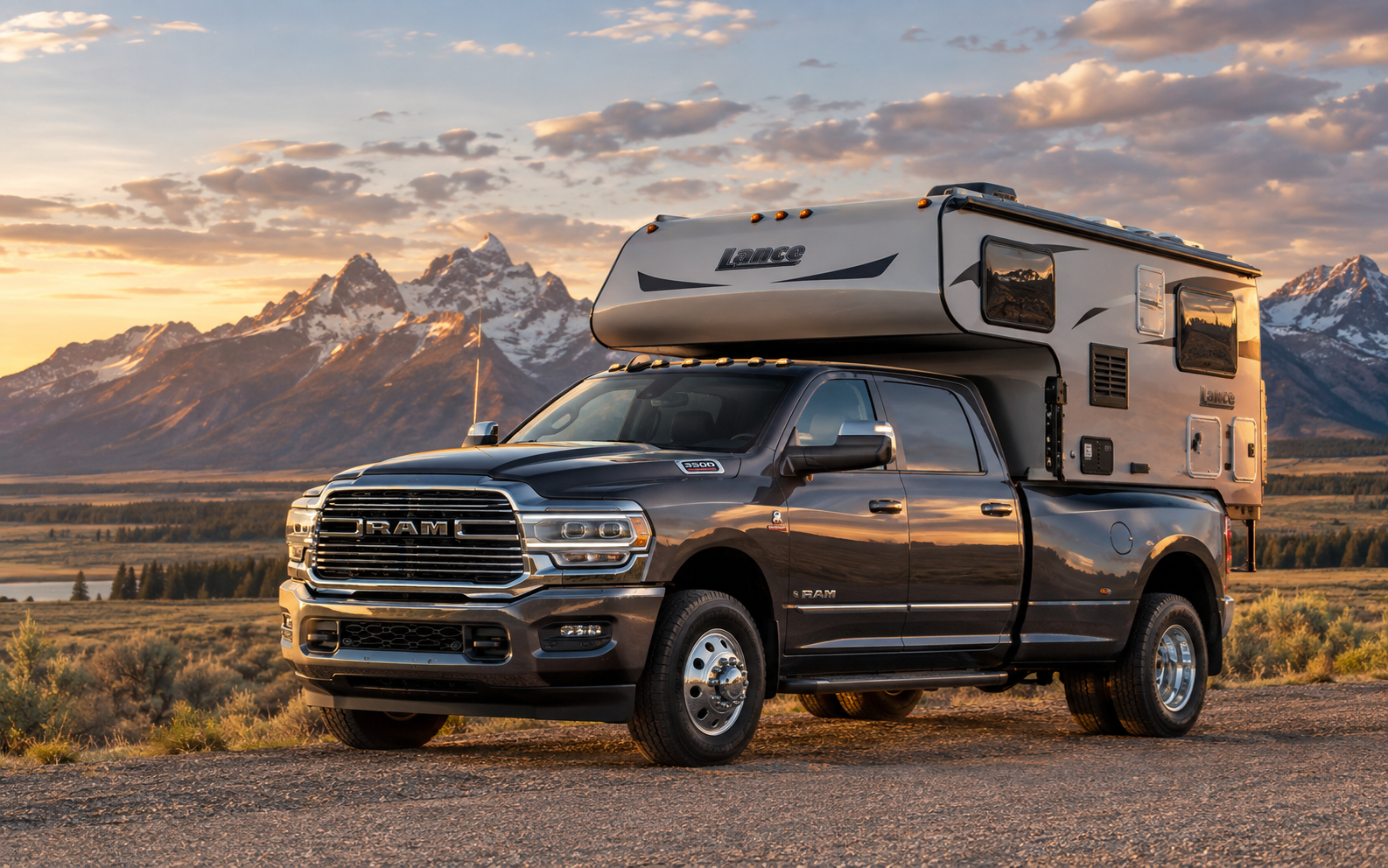
Slide-in campers represent a unique payload challenge because 100 percent of the camper weight rests directly inside the truck bed over the rear axle. Unlike traditional bumper-pull or gooseneck trailers that transfer only a fraction of their total weight as tongue weight, a slide-in camper demands strict attention to net Payload Capacity and Gross Vehicle Weight Rating (GVWR) rather than maximum towing capacity. Placing a heavy hard-side camper into a truck bed raises the center of gravity significantly. When navigating Wyoming mountain passes and crosswinds along the Interstate 80 corridor near Rawlins, having a properly spec'd four-wheel-drive truck is essential for vehicle control and passenger safety. Severe lateral crosswinds exceeding 50 mph through Carbon County can create extreme sway forces against tall camper side walls. High mountain elevations like Togwotee Pass or Elk Mountain thin the ambient air, placing additional demands on engine torque and cooling systems. Our local team at Fremont Chrysler Dodge Jeep RAM Rawlins works with truck owners daily to match their specific camper weight specs to the ideal 4x4 RAM chassis configuration.
Model Breakdown: Which RAM Truck Fits Your Camper Type?
RAM 3500 Dual Rear Wheel (DRW). The Standard for Hard-Side & Slide-Out Campers
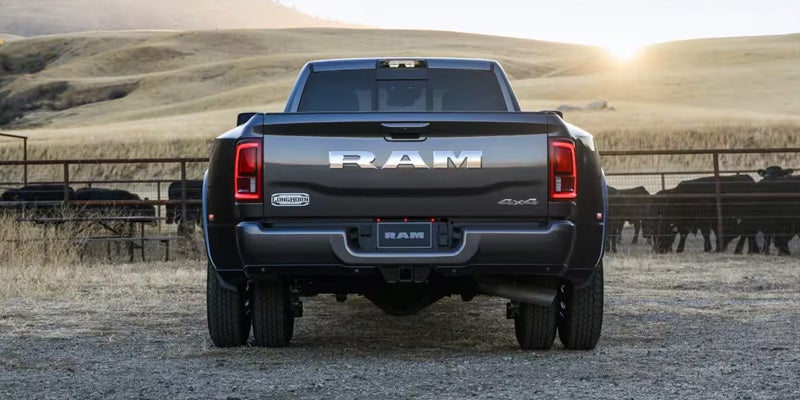
For heavy, fully featured hard-side slide-in campers that feature slide-outs, generator bays, and large freshwater tanks, the RAM 3500 Dual Rear Wheel (DRW) 4x4 stands as the proper heavy-duty platform. With a maximum payload capacity reaching up to 7,290 lbs on 4x4 Regular Cab models, and up to 6,890 lbs on popular 4x4 Crew Cab configurations, a dual rear wheel pickup provides the broad stability cushion necessary for heavy bed loads. The dual wheels on each side widen the rear axle footprint significantly, directly counteracting lateral vehicle sway caused by broadside wind gusts along I-80. For optimal weight distribution, our team at Fremont Chrysler Dodge Jeep RAM Rawlins recommends configuring a RAM 3500 DRW in a Crew Cab 4x4 layout paired with an 8-foot long bed. The 8-foot bed provides the structural floor length required to keep the camper center of gravity positioned forward of the rear axle centerline, maintaining proper front-tire steering traction across slippery or unpaved mountain roads.
RAM 3500 Single Rear Wheel (SRW). Balance of Payload & Daily Flexibility
Truck owners who haul mid-sized hard-side campers or heavy pop-up campers often prefer the versatility of a RAM 3500 Single Rear Wheel (SRW) 4x4 model. A 4x4 RAM 3500 SRW equipped with the standard gas powertrain offers a maximum payload rating of up to 4,520 lbs in Regular Cab trim and up to 4,260 lbs in Crew Cab models. This payload capacity provides a safe margin for non-slide-out hard-side campers while maintaining a narrower body width that fits easily into tight parking spaces, narrow backcountry trailheads, and crowded mountain passes. The single rear wheel footprint reduces vehicle drag on highway stretches while still providing a rigid frame construction and stiff rear leaf-spring suspension designed to manage substantial vertical bed pressure.
RAM 2500 Heavy Duty. Lightweight & Pop-Up Slide-Ins
The RAM 2500 Heavy Duty 4x4 provides an effective option for lightweight pop-up slide-in campers or pop-up aluminum toppers. With a maximum payload capacity of up to 4,010 lbs on 4x4 gas-powered models, the RAM 2500 HD can comfortably manage lower-profile campers. However, truck buyers must account for the weight of the optional diesel engine, which reduces available payload headroom compared to gas configurations. The RAM 2500 HD features a Class-Exclusive five-link coil rear suspension that offers smooth unladen ride comfort. When carrying a slide-in camper, we strongly recommend adding the optional Auto-Level Rear Air Suspension to control rear suspension sag and keep the truck level under load.
RAM 1500 Light Duty. Sizing Limits for Half-Ton Trucks
Light-duty pickups like the RAM 1500 are designed primarily for personal transportation and light towing applications. Across its various trim levels and cab styles, the 4x4 RAM 1500 offers a maximum payload capacity ranging from 1,490 lbs to 2,010 lbs across its 4x4 configurations. While an ultra-lightweight pop-up shell or minimal truck topper can fit within these limits, traditional hard-side slide-in campers quickly exceed the RAM 1500 Gross Vehicle Weight Rating (GVWR). Overloading a half-ton pickup with a heavy slide-in camper can cause severe vehicle instability, excessive brake wear, and suspension bottoming, making a heavy-duty 4x4 RAM 2500 or 3500 the necessary choice for standard slide-in units.
Engine Selection: Mountain Altitude & Torque Performance
Choosing the right engine for hauling a slide-in camper across high elevations requires balancing horsepower, low-end torque, and total engine block weight. Naturally aspirated engines lose air density at high mountain elevations, whereas turbocharged engines force air into the combustion chamber to maintain power output across steep grades.
| Powertrain Option | Horsepower / Torque Specs | Altitude Performance Capability | Slide-In Camper Suitability |
|---|---|---|---|
| 6.4L HEMI® V8 Gasoline | 405 hp @ 5,600 rpm /
429 lb-ft @ 4,000 rpm |
Naturally aspirated engine experiences mild power loss at high mountain passes above 7,000 feet. | Ideal for maximizing net payload capacity due to lighter engine weight. |
| 6.7L Cummins® High-Output Turbo Diesel | 430 hp @ 2,800 rpm /
1,075 lb-ft @ 1,800 rpm |
Turbocharger compensates for thin air, delivering steady torque over high elevation passes. | Exceptional for long-distance mountain hauling with good payload stability. |
The 6.4L HEMI V8 engine provides a significant payload advantage because the lighter cast-iron gas engine block adds less weight to the front axle, leaving more net payload capacity available for the truck bed. However, for truck owners who regularly climb steep mountain grades like South Pass or Togwotee Pass, the 6.7L Cummins High-Output Turbo Diesel engine delivers Best-in-Class available base diesel torque at 1,075 lb-ft. The Cummins turbocharger maintains pulling power in thin mountain air, and the integrated diesel exhaust brake provides controlled engine braking when descending steep highway grades with a heavy camper loaded in the bed.
RAM Features & Factory Packages for Slide-In Campers
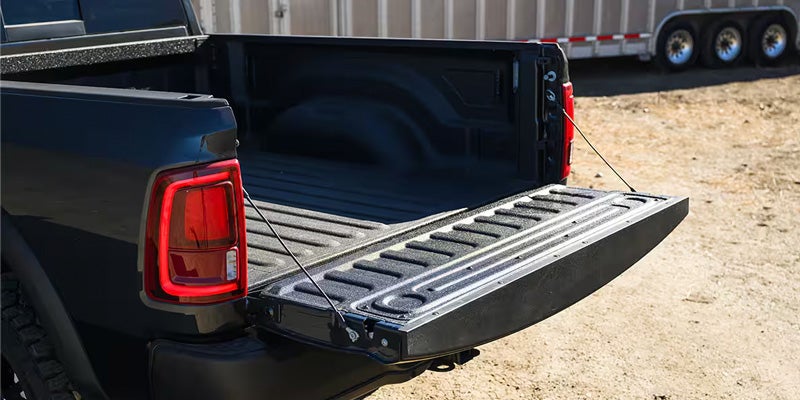
RAM builds several factory features specifically tailored to simplify slide-in camper hauling. The Class-Exclusive Auto-Level Rear Air Suspension uses dual air bladders mounted on the rear axle to automatically level the vehicle when a camper is loaded into the bed. This system maintains proper chassis geometry, preserves headlight aim, and provides manual controls to lower the rear bed height for easier camper loading and unloading.
Visibility around wide camper walls is managed through the Class-Exclusive Power Convex Trailer Tow Mirrors, which extend outward to provide clear views along the sides of wide camper bodies. When a slide-in camper overhangs the rear tailgate and blocks the standard center high-mounted stop lamp, the available Digital Rearview Mirror 3.0 with CHMSL camera relocation kit transfers a video feed from an auxiliary camera directly to the interior rearview mirror.
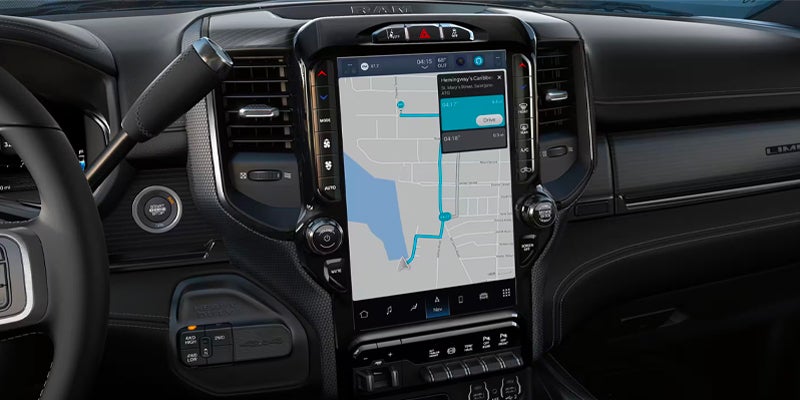
Electrical convenience is provided by the available 2.4kW On-Board Bed Power Inverter, which supplies 110-volt outlets directly inside the pickup bed to run power tools, lights, or camp accessories without starting a standalone generator. To keep camper auxiliary battery banks fully charged while driving, RAM offers optional Dual 220-Amp Alternators on heavy-duty models to deliver high electrical output. Ordering the factory Fifth-Wheel / Camper Prep Group equips the bed floor with structural mounting provisions and an integrated 7-pin wiring harness inside the bed wall for seamless electrical connection to the camper unit.
How to Calculate Your True Slide-In Camper Payload
Calculating exact available payload capacity requires straightforward arithmetic using factory specs. First, locate the specific Tire and Loading Information sticker located on the driver side door jamb of the truck. This yellow-and-white label lists the precise maximum payload capacity for that specific vehicle as configured from the factory.
Second, calculate the wet weight of your slide-in camper. The manufacturer dry weight printed on the camper tag does not include freshwater, full propane tanks, onboard batteries, or personal gear. Add 8.3 lbs per gallon of fresh water, 4.2 lbs per gallon of propane, plus the weight of all cookware, clothing, supplies, and aftermarket camper jacks to determine true wet weight.
Third, add the total weight of all vehicle occupants, cab cargo, tools, and aftermarket accessories installed on the truck, such as heavy floor mats or bed liners. Subtract this combined passenger and cab cargo weight from the factory payload figure listed on the door jamb sticker.
Fourth, verify that the total wet weight of the camper is less than or equal to the remaining available payload figure. Finally, take the completely loaded truck and camper to a certified vehicle scale to verify that the front axle weight, rear axle weight, and total gross vehicle weight do not exceed the official Gross Vehicle Weight Rating (GVWR) listed on the safety compliance label inside the driver door jamb.
Local Expertise: Why Buy Your Camper Rig at Fremont CDJR Rawlins?
Selecting the ideal RAM truck for a slide-in camper requires local knowledge of Wyoming terrain and accurate technical specification. At Fremont Chrysler Dodge Jeep RAM Rawlins, our team understands the demands of hauling heavy loads through Carbon County crosswinds, across rough gravel ranch roads, and up high-elevation passes. We stock a heavy-duty 4x4 inventory pre-configured with factory options like the Fifth-Wheel / Camper Prep Group, heavy-duty alternator upgrades, and tow technology packages.
Whether you need a RAM 3500 Dual Rear Wheel 4x4 for a fully equipped hard-side camper or a RAM 2500 Heavy Duty 4x4 for a lightweight pop-up unit, our truck specialists guide you through exact payload calculations to verify safety and regulatory compliance. We also assist customers with custom factory ordering to build a vehicle to exact axle ratio, bed length, and suspension specifications.
Frequently Asked Questions
Can a RAM 2500 with rear coil springs handle a slide-in camper?
A RAM 2500 Heavy Duty equipped with the standard five-link coil rear suspension can carry lightweight pop-up slide-in campers or aluminum truck toppers provided the total wet weight stays within the vehicle door-jamb payload limit. Because coil springs are tuned for unladen ride quality, heavy bed loads can cause rear suspension sag. Equipping the RAM 2500 with the optional Auto-Level Rear Air Suspension levels the chassis, restores proper headlight alignment, and maintains stability under load.
Is a Dual Rear Wheel (DRW) configuration mandatory for a slide-in camper?
A Dual Rear Wheel setup is not mandatory for lighter pop-up campers or compact hard-side units, which fit within the payload limits of a RAM 3500 Single Rear Wheel or RAM 2500 Heavy Duty pickup. However, for large hard-side campers featuring slide-outs or heavy appliances, a RAM 3500 DRW 4x4 is strongly recommended. The dual rear wheels broaden the rear stance to resist top-heavy body roll caused by strong broadside winds on open Wyoming highways.
How does the Auto-Level Rear Air Suspension help when carrying a heavy bed load?
The Class-Exclusive Auto-Level Rear Air Suspension uses automatic sensors to detect vehicle ride height changes when weight is added to the truck bed. The system inflates rear air bladders to keep the chassis level, preventing rear-end squat and keeping full steering control on the front axle. It also provides driver-selectable ride modes, allowing owners to lower the rear bed height to simplify camper loading and unloading procedures.
How does choosing a diesel engine affect total payload capacity?
Choosing the 6.7L Cummins High-Output Turbo Diesel engine adds weight to the front chassis due to the heavier cast-iron engine block and turbocharger assembly compared to the 6.4L HEMI V8 gas engine. Because payload is calculated by subtracting total vehicle curb weight from Gross Vehicle Weight Rating (GVWR), the extra weight of a diesel engine reduces net available payload capacity. Truck buyers seeking maximum net payload weight often select the 6.4L HEMI V8, while buyers prioritizing mountain climbing power choose the diesel engine.